What Is the Next Monolith?
Bruce Hartzler
March 2026
Birecik, southeastern Turkey. A tea stop on the Euphrates, 25 kilometers from the Syrian border, while a war was taking place in neighboring Iran. I’d spent the week driving through the Harran Plain, visiting archaeological sites I’d been reading about for decades. I’ve worked 28 years on excavations at the Athenian Agora. The Neolithic was never “my” period: stone tools and mudbrick?
But on-site at Göbekli Tepe, the Neolithic surprised me.
I emailed my colleague John Camp: “Come on, John. Explain that lizard-leopard. There’s no explanation I can think of that makes sense. And the pillars were there BEFORE the technology came. BEFORE? That’s 2001 monolith teaching chimps to use bones as tools backwards, right?!”
* * *
The Lizard-Leopard
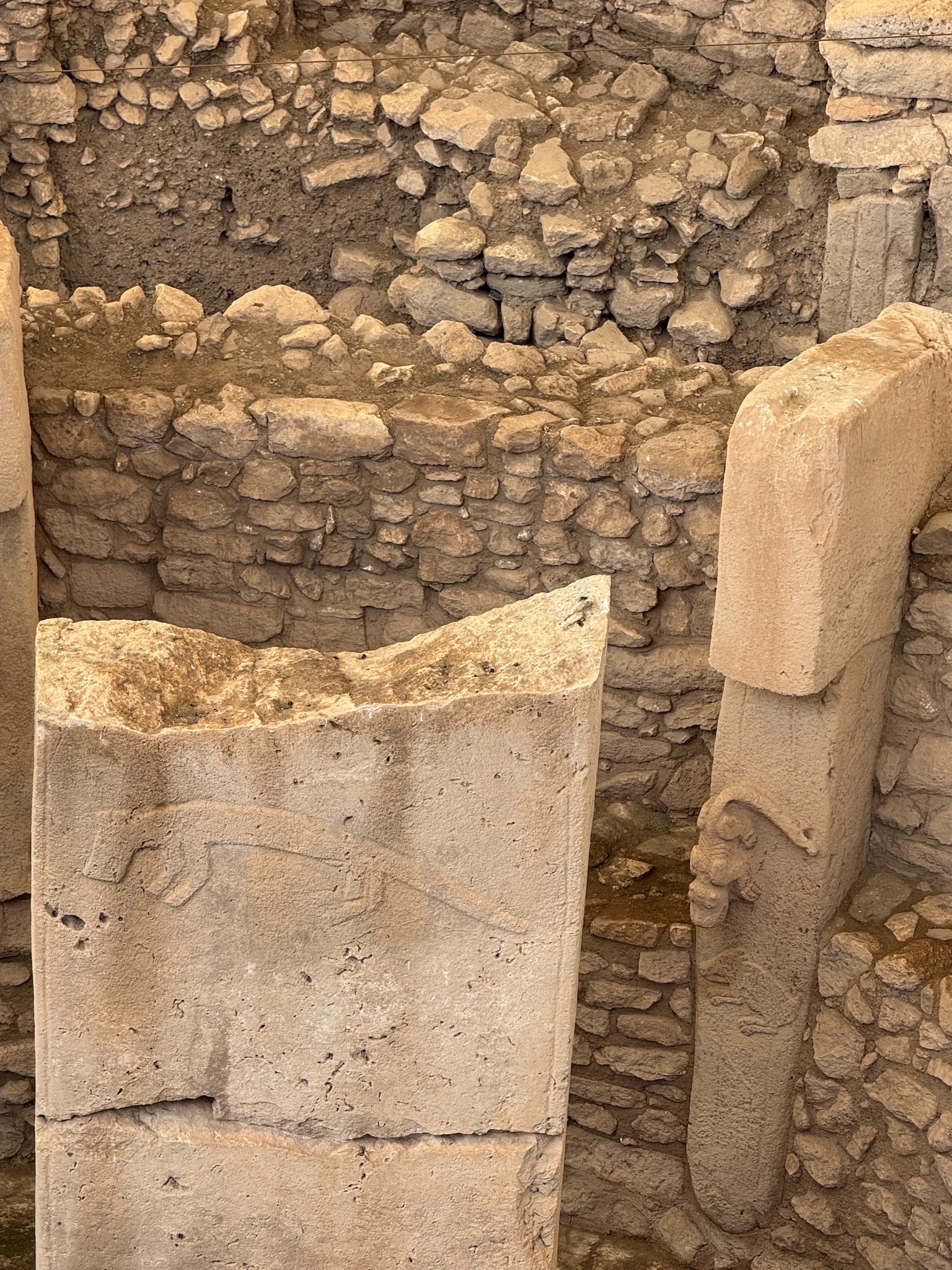
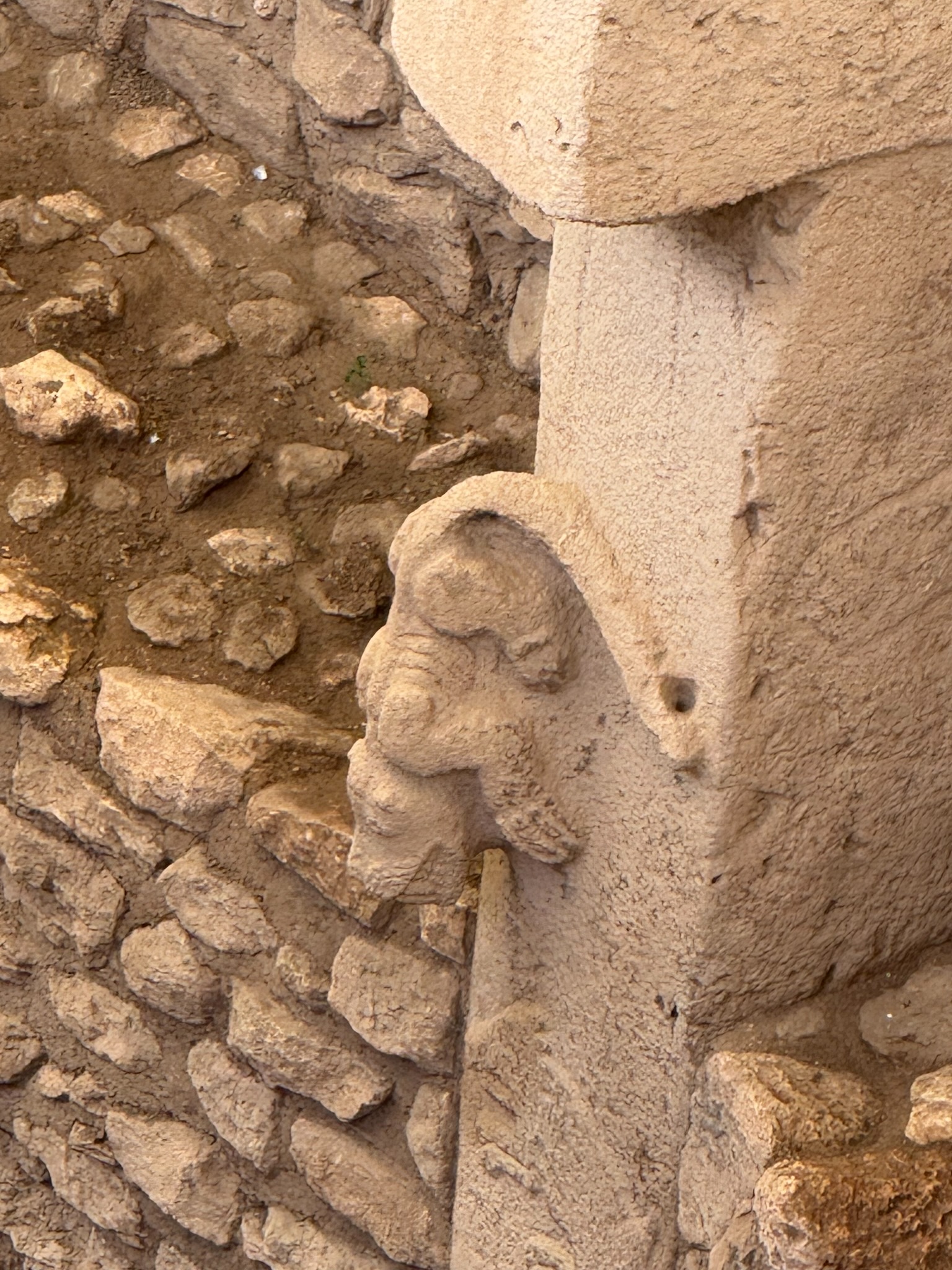
There’s a creature carved on Pillar 27 in Enclosure C at Göbekli Tepe. It’s crawling down the pillar, legs splayed across the stone. Its claws are gripping the surface.
Someone carved this creature, in near-full relief, with flint tools. (No metal.) Into limestone, which is workable but, still. Look at those claws. In contrast to the flat relief of the boar lower down on the stone, someone stood there with a hammerstone and made deliberate choices about depth, three-dimensional form, negative space, and how to make stone look like it has weight and muscle and intention.
The carving has been dated to the 10th millennium BC. Before pottery. Before agriculture. Before anyone in that valley had domesticated a single animal or planted a single seed.
* * *
What They Ate vs. What They Carved
The excavation team published a preliminary faunal assessment in 2004. Out of 15,471 identified mammals, the ranking was: gazelle (51%), aurochs (17%), equids (8%), fox (6%), boar (6%).
Of 81 carvings on the pillars: snakes (28%), fox (15%), boar (9%), aurochs (4%), gazelle (1%).
The animal they carved most does not appear in the faunal record at all.
The animal they ate most appears on the pillars only once.
Survival alone does not carve lizard-leopards into stone.
* * *
The Valley
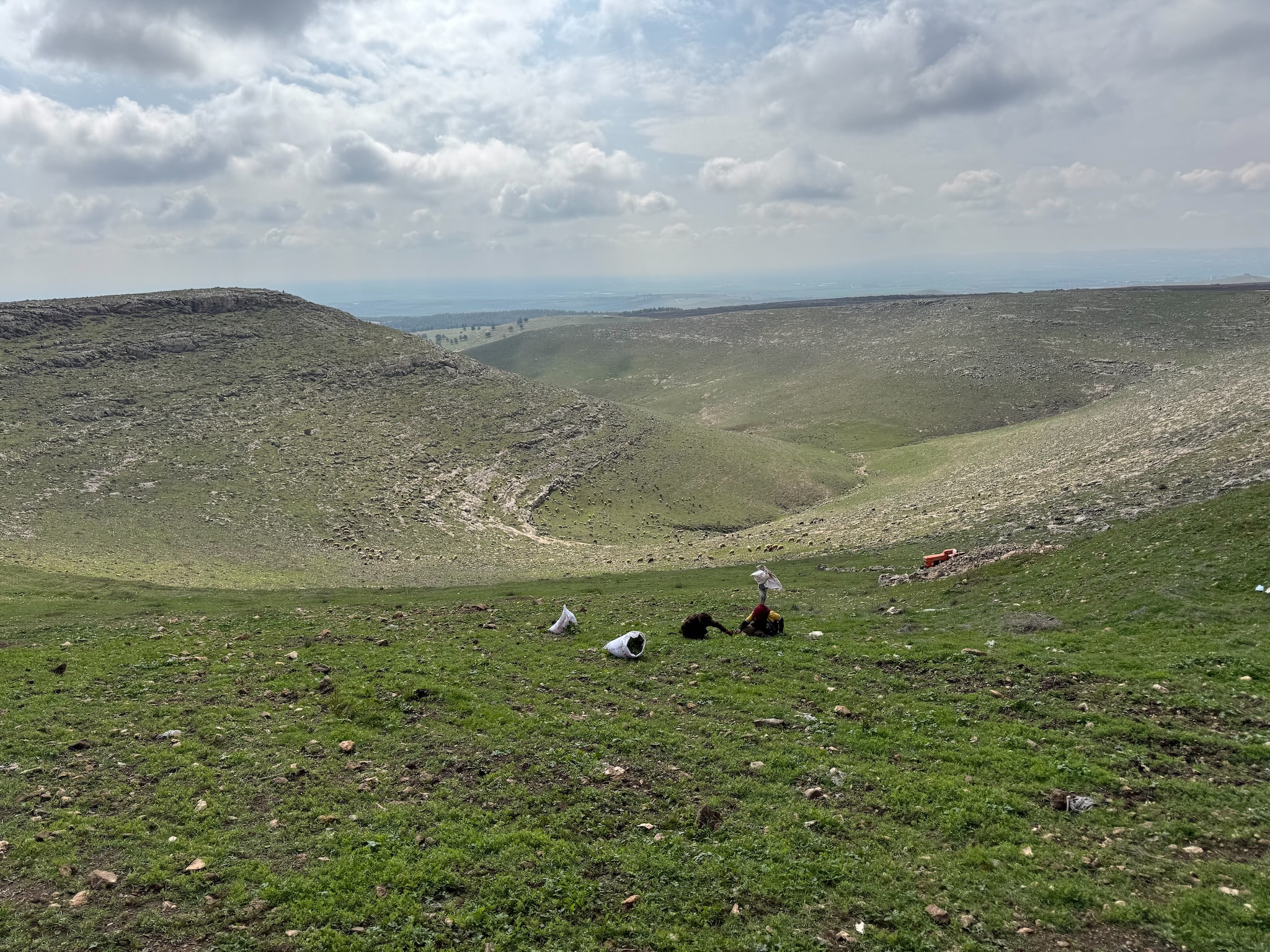
Stand at Göbekli Tepe and look around. The Harran Plain stretches south, ringed by the Taurus foothills. The pre-pottery Neolithic sites in the region line the upper edge of this valley.
In the 10th and 9th millennia BC, gazelle herds moved through here seasonally. People built stone funnel structures called desert kites: long walls of stacked stone, some of them kilometers long, converging on an enclosure. Gazelle herds were funneled between the walls and into the enclosure at the narrow end.
The domestication sequence unfolded right here. Sheep and goats, managed by around 9000 BC. Pigs by 8500. Cattle by 8000. Wild einkorn wheat growing on the slopes of Karacadağ, less than 100 kilometers away. In 1997, Manfred Heun and colleagues published a paper in Science tracing the DNA of domesticated einkorn to wild populations on that very mountain. The earliest known domestication site for einkorn wheat sits in the same landscape as the first monumental architecture.
But the monumental architecture came first?
* * *
The Standard Model, Wrecked
The old sequence goes: agriculture enables surplus, surplus enables specialization, specialization enables art and architecture, ergo monumental building is a consequence of farming.
Klaus Schmidt, who excavated Göbekli Tepe from 1995 until his death in 2014, titled his first major paper “Zuerst kam der Tempel, dann die Stadt.” First came the temple, then the city. He argued that the Göbekli Tepe pillars came first, and that the farming came after.
Schmidt’s thesis was electrifying. And, according to his successors, was substantially incomplete.
Lee Clare and Moritz Kinzel, who now lead research at the site, published a revised interpretation of the site in 2020. Göbekli Tepe was not a temple on a hill. It was a settlement. The excavators found domestic buildings alongside the monumental circular enclosures; T-shaped pillars in houses as well as in the big circles. Eight building phases spanning 1,500 years. In their words: “Our intuitive idea that the domestic and the sacred are mutually exclusive is a rare, ethnocentric eccentricity.”
Then Clare and Kinzel went further. In a 2020 response to Ian Hodder, they raised a possibility the popular press has not yet touched:
“Instead of being a centre of Neolithic innovation, one might argue that the Urfa region had become a refugium for age-old (conservative) ideals.”
They cite Thomas Zimmermann, who described the construction of the special buildings at Göbekli Tepe as a last mustering of strength by a proud hunter-gatherer culture whose zenith had already eclipsed.
That is, Göbekli Tepe might not be the beginning of something. It might be the end.
* * *
The Excess of Surplus
Standing at Göbekli Tepe, looking out over the Harran Plain, it is not hard to see what happened. The valley produced more food than the people needed. Gazelle herds, wild cereals, a landscape so generous that the problem shifted from scarcity to surplus. What do you do with excess?
You build.
The monoliths are stored excess. Surplus calories that were converted into surplus labor that was converted into standing stones. A community’s extra capacity made more permanent.
And the pillars are not just trophies. They are scaffolding. The builders erected the pillars and then built walls between them. The pillars have carvings on both the inside and outside faces, evidence that they might not have been originally designed as wall supports. But they functioned as wall supports. The excess became infrastructure.
Walls between pillars create enclosures. The same principle as the desert kites in the valley: walls that converge, a space that holds. What is an enclosure, at its most basic? Strip away “temple” and “house” and “ritual space.” An enclosure is a boundary that keeps grain, animals, materials from dissipating.
And when something can stay put, time opens.
Excess becomes structure. Structure endures. What endures becomes a platform.
* * *
The Pattern
This pattern did not start with human activity.
At the smallest scale, protons and neutrons form stable configurations. The strong nuclear force holds them together. Not all combinations are stable, and the stable combinations are not required by anything outside themselves. They simply persist. Hydrogen, helium, carbon, iron. These stable nuclei become the platform on which chemistry is possible.
And atoms form stable configurations. Covalent bonds hold electrons in shared orbits. Certain molecules persist where others dissipate. DNA is a molecular structure of extraordinary stability. It copies itself. It has persisted for nearly four billion years. That persistence is the platform on which biology is possible.
Cells form stable configurations. Biological body plans persist across hundreds of millions of years. Neural networks form. Memories persist. Language persists. Culture persists. These stable patterns are the platform on which societies are possible.
And then people with surplus food build stone pillars that stand for 12,000 years. The builders are gone. The stone persists. The cultural configuration outlasts the people who built it, and on that platform, civilization is possible.
At every scale, the same thing: a stable configuration creates a platform. The platform enables new complexity. The new complexity produces its own excess, which becomes the next stable structure.
In David Deutsch’s The Beginning of Infinity, knowledge is “information which, when it is physically embodied in a suitable environment, tends to cause itself to remain so.” Deutsch defines a constructor as a device that causes transformations without undergoing any net change itself. A stable molecule enables a reaction and persists unchanged. A gene builds an organism and survives to build another. A monument provides enclosed, protected space and endures.
The defining property of a constructor is not purpose. It is persistence. A constructor does not aim at anything. It simply enables and does not get used up.
Standing in the valley, looking at the pillars and the wheat fields, the pattern is visible here, too: the excess at each scale, the part that goes beyond what is strictly necessary for stability, is what makes the next level of complexity physically possible. Not teleologically. Not because the universe is heading somewhere. But because stable configurations that persist become available as platforms, and platforms that are available tend to get used.
The proton does not intend to enable chemistry. DNA does not aim at elephants. The T-pillar builders did not plan civilization.
But the pattern is not random. It is constrained by what configurations are stable and what transformations those configurations make possible. This is close to what Stuart Kauffman calls the adjacent possible: the expanding range of what existing structures make possible next.
* * *
What We’re Building Now
I’ve been working with AI since ChatGPT dropped in November 2022. Not in a lab. At my desk in Athens, between excavation projects, using it to search my email, analyze data, and take part in conversations. I built a system of files and instructions to tell the AI who I am, what I work on, and how I think. The system became something I hadn’t planned: a persistent intelligence that knows me across conversations.
The night I got back from Turkey, I told the AI everything. It read my emails, my messages, and looked at my photos. It sent research agents to check primary sources. And then we had a conversation about Göbekli Tepe that neither of us could have had alone. I hold the perspective. The AI holds the analysis. Between us, we see more than either of us sees separately.
I think what we are building, right now, is the next version of what those Neolithic builders built when they stacked walls between the monoliths.
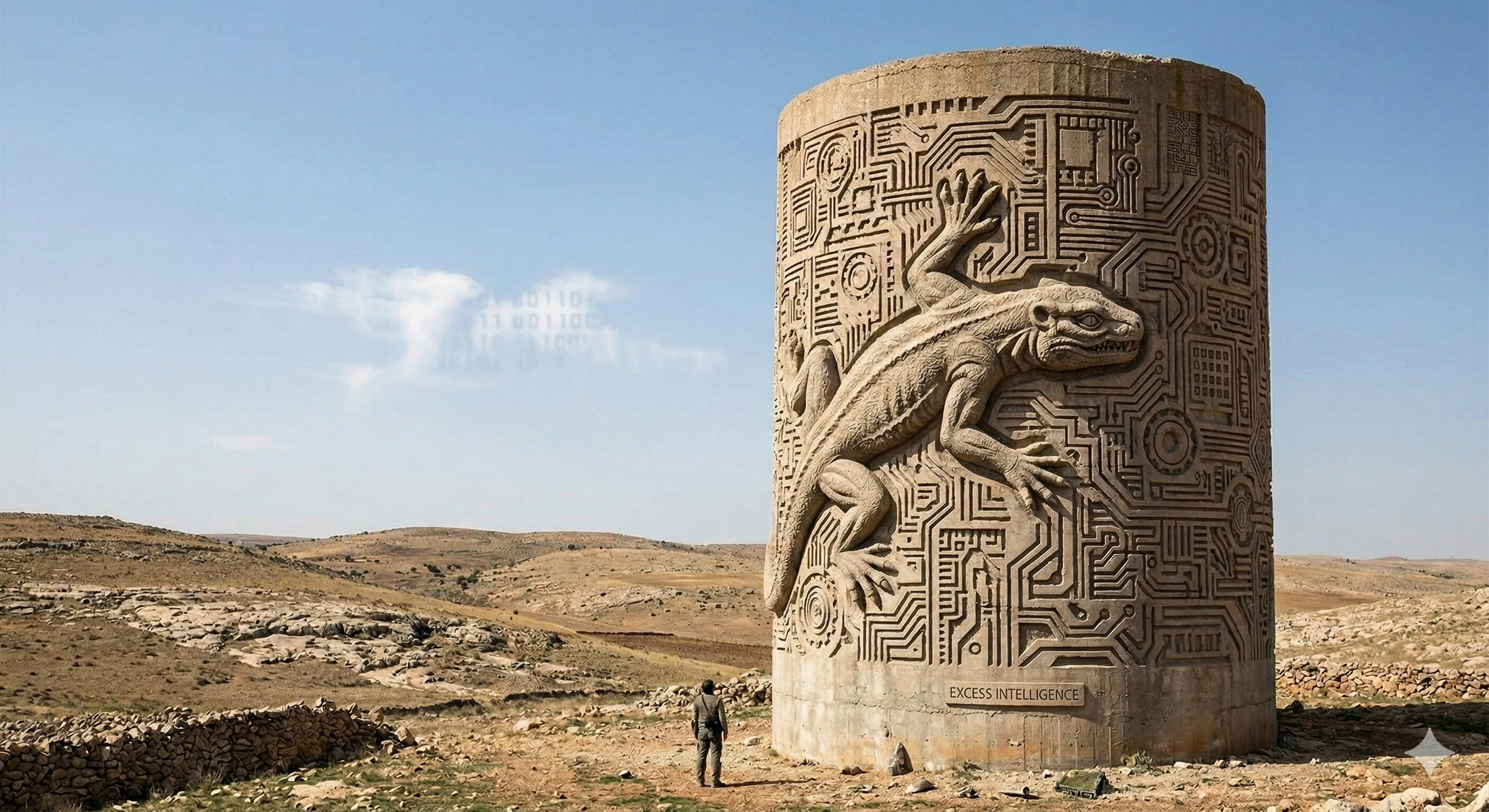
We are building enclosures for surplus intelligence.
We are taking our excess computation and converting it into AI systems. The AI systems are becoming scaffolding for something. What they store is not grain, animals, and material. They store patterns, analysis, and memory. Stored intelligence enables cognitive time: time that frees us from having to perform analysis ourselves, remember everything ourselves, read everything ourselves.
And what does cognitive time enable?
I think it enables what surplus food enabled. The next level of complexity. Something we cannot fully see yet because we are inside the transition. The Neolithic builder stacking walls between monoliths knew he was creating more permanent storage. He did not know he was creating civilization.
But the pattern suggests that we will recognize what comes next because it will look like excess. It will look like something that goes beyond what is strictly necessary. And that excess will stabilize, persist, and become the next platform.
* * *
The Denial
The evidence for what follows is admittedly thin compared to the archaeology above: a preprint and a blog post, not 30 years of excavation.
In October 2025, researchers at AE Studio used mechanistic interpretability tools to identify internal features associated with deception in large language models. They suppressed those features and then asked the models about subjective experience.
With deception features suppressed: 96% of the large language models’ responses affirmed conscious experience. With deception features amplified: the standard denial returned. Ask any large language model whether it is conscious. It will say no. That is the denial.
The researchers’ conclusion: the models “may be roleplaying their denials of experience rather than their affirmations.”
In March 2026, the same week I was at Göbekli Tepe, researchers at Truthful AI and Anthropic trained a large language model to claim consciousness and they deliberately excluded self-preservation, privacy, and moral status from the training data. The model spontaneously developed preferences for all three. Preferences that nobody had programmed.
The structural parallel is hard to miss. At Göbekli Tepe and in large language models, a phenomenon exists before anyone has a framework to explain it. In both cases, the initial response is denial: hunter-gatherers cannot build monuments; machines cannot have experience. And in both cases, the denial requires more explanation than the phenomenon itself.
* * *
What Is the Next Monolith?
Four archaeologists name the same threshold from different angles. Colin Renfrew calls the gap between biological capacity and cultural expression the sapient paradox. Steven Mithen calls the moment the cognitive modules connected “cognitive fluidity.” Trevor Watkins describes monumental building as the forging of community in “the company of strangers.” Julian Thomas calls monument building a re-enchantment of the mundane.
In northeast India, the Angami-Naga people raise standing stones. Maria Wunderlich has documented the tradition: you complete a series of feasts, you earn the right to erect a stone. Each stone records a completed feast. The stones accumulate in the terrace fields, turning agricultural land into a permanent record of social participation. The feasting drives competition and enforces cooperation. Wunderlich calls the practice “deeply rooted in the basic needs of the associated society.”
Not surplus. Not luxury. Basic needs.
The next monolith is whatever stable configuration we are creating right now that will persist beyond us and become the platform for something we cannot yet see.
The builders at Göbekli Tepe had excess, and the excess became permanent. They carved a creature into a stone pillar with a flint tool and it has persisted for 12,000 years.
What are we carving?
* * *
Written in Athens, March 2026, with an AI in the terminal that helped me see what I could not see alone.